
Blog
When is a standard CRM enough — and when is it not?
A standard CRM can be a very good solution for a company. There is no need to develop a custom system just because the company works a little differently from everyone else.
An off-the-shelf CRM is usually faster to introduce, has predictable costs and offers the functions most sales teams genuinely need.
If it covers the way the company works well, there is no reason to replace it.
The question arises when the larger part of the real work starts to happen outside it.
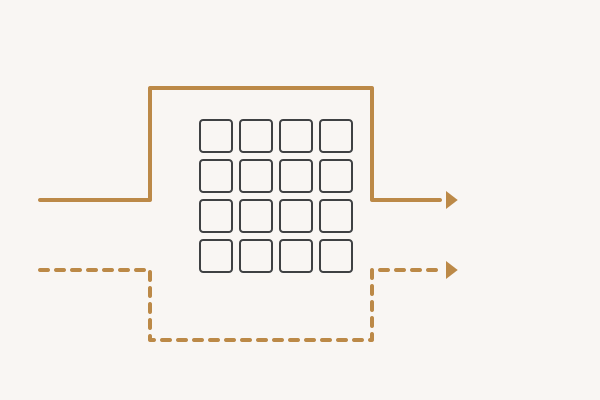
When the CRM is only one piece of the puzzle
The typical situation looks unremarkable.
Contacts and opportunities are in the CRM. Quotes are created elsewhere. Contracts are on a drive. Invoicing has its own application. Tasks are handled in yet another tool, and management gets its overview in a spreadsheet that somebody has to update regularly.
None of these tools has to be a bad one.
The problem is that information which genuinely belongs together is not connected in the systems being used.
So people copy details over, check several places, or create their own workarounds.
A good CRM does not have to copy every detail of your work
A certain amount of adapting the company to the software is normal.
If changing a simple internal procedure makes it possible to use a good standard solution at a significantly lower price, that may be exactly the best decision.
The purpose of a custom system is not to set every current process in stone.
What matters is telling the difference between a procedure that can be changed without trouble and a part of how the company works that is essential to it.
If the software forces people to bypass sensible processes, keep important data on the side, or repeatedly do work the system could take over, it is worth looking for another way.
How to tell that the current CRM is no longer enough
One strong signal is when people start to bypass it. Important notes stay in e-mails, separate records appear in spreadsheets, and the reports in the CRM gradually stop matching what is actually happening in the company.
Another signal is the amount of work around the system itself. If people have to copy data repeatedly or check that it matches across several applications, the problem may no longer be in the individual CRM functions, but in the whole architecture of working with information.
Sometimes the CRM does not need replacing
The decision is also not only between a standard CRM and a completely custom system.
The existing CRM can continue to handle sales well, and a custom solution can cover only the part the standard tool cannot manage. Where possible, the two systems can be connected.
Elsewhere it makes more sense to replace several tools with one system in which the individual agendas follow on from each other directly.
The right option therefore cannot be determined from a list of features. First you have to understand where the current solution genuinely limits the company's work, and how much time and money that problem costs.
Only then does it make sense to decide whether to configure, integrate, change — or develop.
Further reading
You might also like
First step
Dealing with this right now?
We start with a fixed-price analysis. The output is yours, even if you build with someone else.